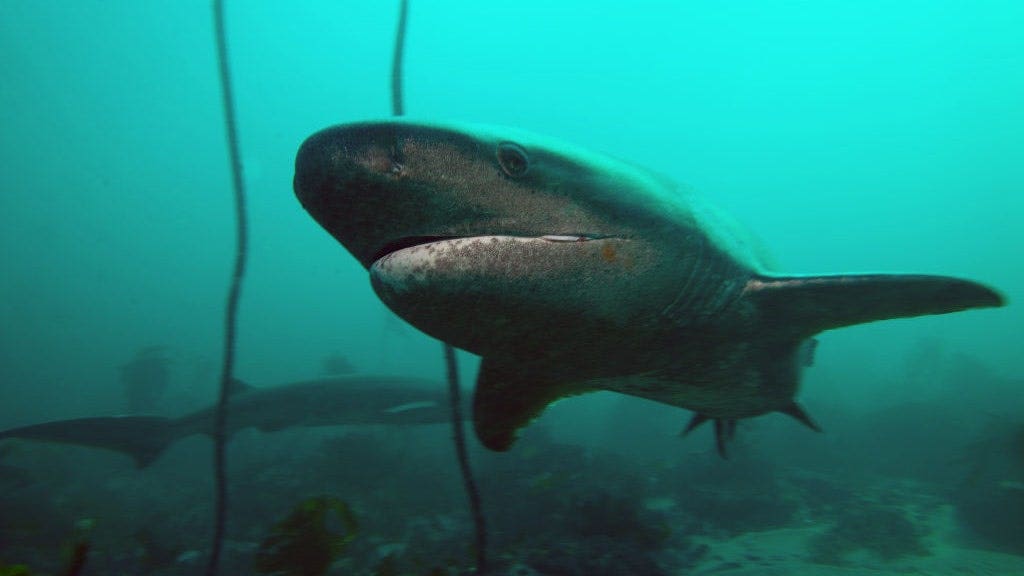
A remarkable video showing a massive sixgill shark approaching an underwater submarine has resurfaced on social media, attracting attention from viewers fascinated by the mysterious deep-sea predator. The footage was captured by OceanX, an ocean exploration nonprofit founded by billionaire investor Ray Dalio and his son Mark Dalio, during a scientific expedition near the Bahamas in June 2019.
Although the video has recently circulated again, the encounter is not new. The footage originally showed a bluntnose sixgill shark swimming close to a research submersible, giving scientists an unusually clear view of a species that spends much of its life hundreds of meters beneath the ocean’s surface.
Who Filmed the Viral Sixgill Shark Video?
The viral sixgill shark footage was recorded during an OceanX expedition aboard the research vessel Alucia. The organization worked with marine scientists and filmmaking professionals to document the behavior of deep-sea sharks in their natural environment.
The extended documentary was produced by OceanX and One Big Wave, with Janssen Powers credited as director, producer, editor and director of photography. Andy Mann and Julien Jarry provided additional camera work, while Mark Dalio served as executive producer.
During the expedition, researchers used the submersible Nadir to approach sixgill sharks at considerable depths. One particularly large female shark moved toward the vessel and appeared to investigate its viewing window, creating the dramatic encounter that later spread widely online.
OceanX published the short video in July 2019 and subsequently released an extended documentary explaining the scientific mission.
What Is OceanX and Who Founded It?
OceanX is a nonprofit ocean exploration organization established by Ray Dalio and his son Mark Dalio. It operates as an initiative of Dalio Philanthropies and combines marine research, advanced underwater technology and documentary filmmaking.
Ray Dalio is widely known as the founder of Bridgewater Associates, while Mark Dalio has worked in filmmaking and ocean-related media projects.
The organization began its work in 2016 and publicly announced its broader OceanX initiative in 2018. Its mission involves exploring poorly understood marine environments and sharing scientific discoveries with audiences worldwide.
OceanX has also collaborated with major documentary producers, including BBC Earth and National Geographic. Its work contributed to Blue Planet II, while its exploration projects were featured in the documentary series OceanXplorers.
Where Was the Sixgill Shark Video Recorded?
The famous encounter occurred in waters near Cape Eleuthera in the Bahamas during a research mission in June 2019.
Scientists were studying bluntnose sixgill sharks, a large species scientifically known as Hexanchus griseus. These sharks can grow beyond 15 feet in length and generally inhabit deep ocean environments, making close observations difficult.
The research team used bait to attract sharks toward the submersible while cameras documented their movements.
The footage became particularly memorable when a large female sixgill approached the submarine and moved close to its window. The animal’s broad head, unusual eyes and enormous body were clearly visible.
The encounter was part of a larger scientific effort rather than an accidental discovery.
Why Were Scientists Studying the Sixgill Shark?
The main objective of the expedition was to attach a tracking device to a sixgill shark while it remained in its natural deep-water habitat.
Marine scientist Dr. Dean Grubbs of Florida State University had previously studied these sharks using satellite tags. However, traditional tagging methods often required bringing the animals toward the surface, potentially affecting their behavior.
The OceanX expedition attempted a different approach by deploying tracking equipment directly from a submersible.
After several unsuccessful attempts, researchers successfully tagged a large male sixgill shark during the fourth night of the mission.
The achievement demonstrated that scientists could collect information about deep-sea predators without first bringing them to the surface.
Why Is the Sixgill Shark Video Going Viral Again?
The footage resurfaced on social media on November 22, 2026, with viewers sharing clips of the shark approaching the submarine.
Its enormous size and prehistoric appearance have contributed to renewed curiosity. Sixgill sharks belong to an ancient evolutionary lineage and possess six pairs of gill slits, unlike most modern sharks, which have five.
The video has circulated several times since its original release, sometimes without clear information about when or where it was filmed.
OceanX has continued its research beyond the Bahamas expedition, including further sixgill shark studies in the Azores using its advanced research vessel OceanXplorer.
The renewed attention highlights the importance of the original mission, which combined scientific research with underwater filmmaking to document one of the ocean’s least understood large predators. While the viral encounter happened years ago, the footage continues to introduce audiences to marine life rarely seen in such detail.